Doors off, degreased, sprayed and cured properly, so the finish still looks right after a year of cooking. Our own crew, and a written warranty on the work.
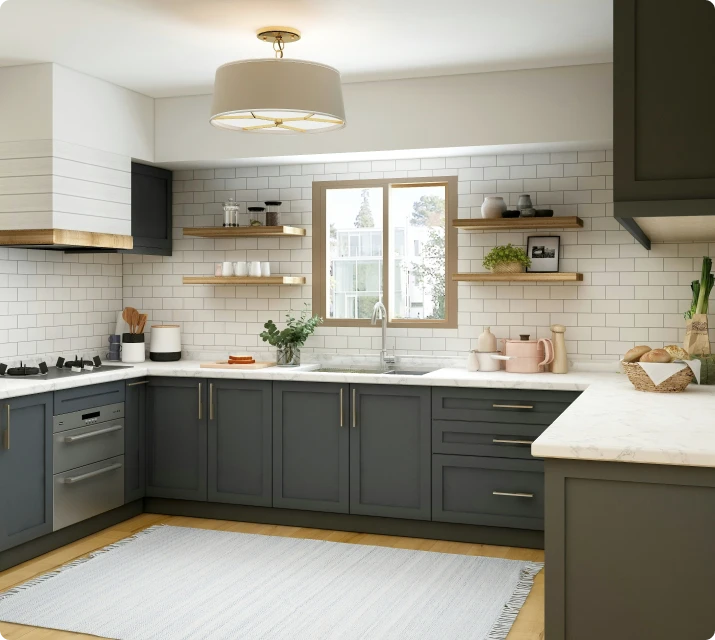
Why does a kitchen cabinet finish fail when the same paint on the same house’s trim is fine 10 years later?
Because a kitchen is the harshest interior surface in the building. Doors get opened with wet hands and closed with a hip. A film of cooking oil settles on everything within reach of the range, including the cabinet faces, and it is invisible until you wipe one with a degreaser and see the line. Under the sink, the cabinet lives in a damp box.
None of that makes cabinets a bad candidate for paint. It makes them a job where the prep decides everything, and where the difference between a two-day job and a proper one shows up in month eight.
Look at the boxes, not the doors. If the cabinet boxes are solid, square, and laid out the way you want the kitchen to work, you have good bones and the doors are a finish question. If the boxes are swollen at the base, sagging, or the layout is the thing you actually hate, paint will not fix that and we will say so.
Most kitchens in this county fall in the first group. A lot of the mid-county housing stock is 1970s through 1990s construction with solid plywood or well-built particle boxes and dated door styles or a wood tone nobody wants any more. Those kitchens paint beautifully.
Painting also keeps you in your kitchen. A refinish runs in days rather than weeks, the plumbing never comes out, and there is no demolition, no dumpster and no drywall repair afterward.
The order matters more here than on any other interior surface. This is our sequence.
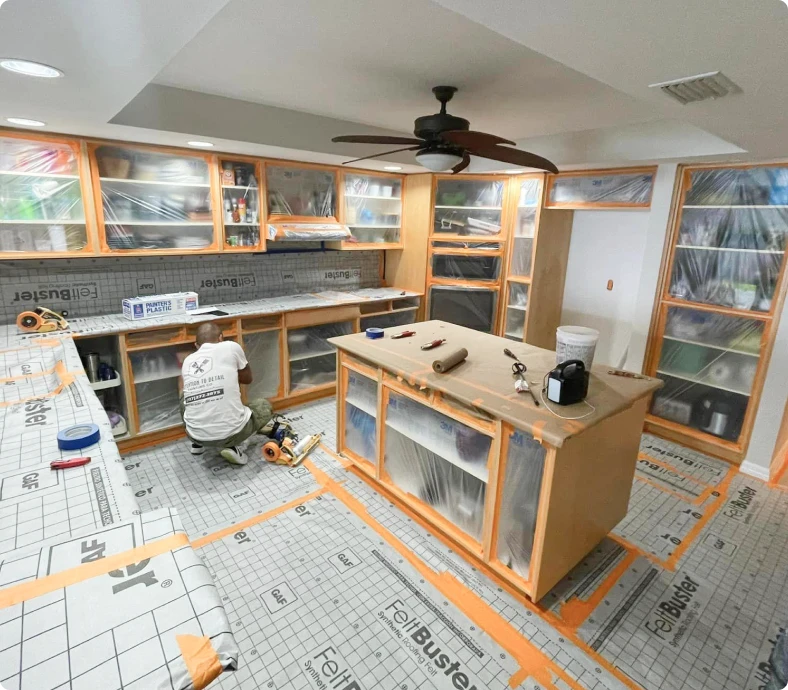
Every door and drawer front comes off and gets numbered to its opening. Hinges, pulls and drawer slides come off with them. Kitchens are rarely as symmetrical as they look, and a door hung back in the wrong opening never quite closes right.
Plastic on the openings, floor protection, and a taped-off spray area away from the living space. We set up so you can still use the sink and the refrigerator through most of the job.
This is the step that separates a finish that lasts from one that peels around the range in a year. Every face gets cleaned with a degreaser rated for cooking residue, then rinsed, and the area around the cooktop gets a second pass.
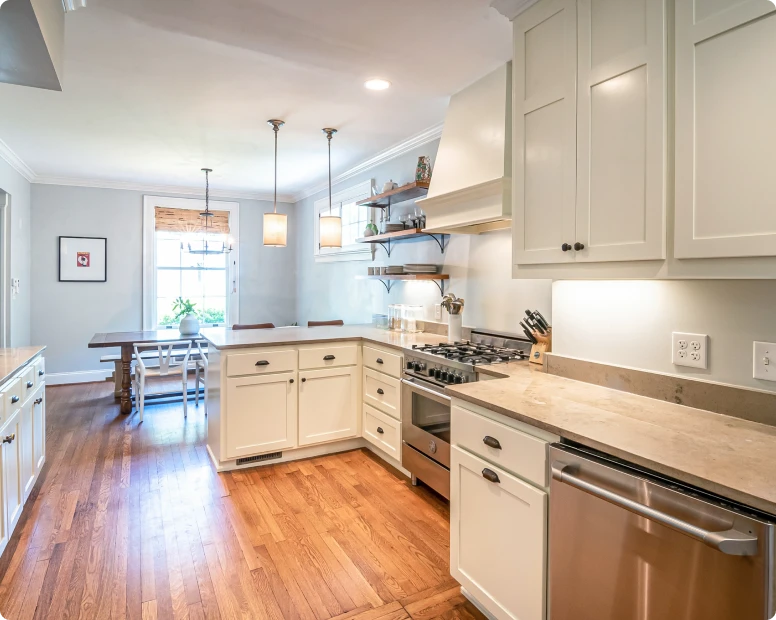
A factory finish is smooth and closed. We scuff every surface so the primer has something mechanical to hold onto, then vacuum and tack the dust off.
Chips, dings, worn edges, blown-out screw holes in the hinge stiles, and any door that needs a joint re-glued.
A primer chosen for the substrate you have: raw wood, a factory conversion varnish, thermofoil, or laminate. The wrong primer on the right cabinet is still a failure. Where an old wood stain could bleed through a light finish, we block it.
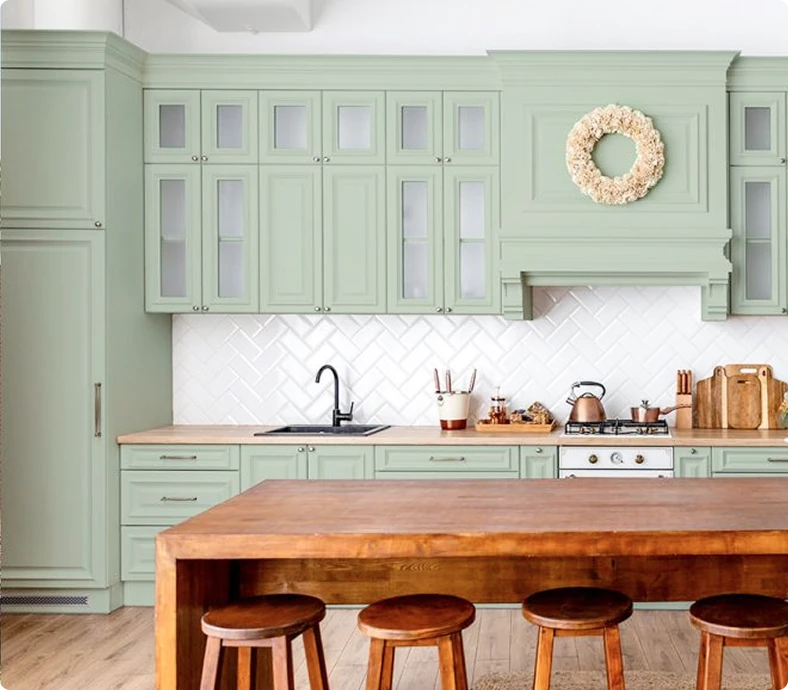
Doors and drawer fronts get sprayed flat and horizontal, which is how you get a surface with no brush texture. Boxes and face frames get sprayed in place behind containment. Multiple thin coats, sanded lightly between.
Cabinet coatings reach full hardness over days, not hours. We reinstall on the product’s schedule and we tell you when the doors can be used normally and when you can put liners and heavy items back.
Doors back in their numbered openings, hinges adjusted so every gap is even, hardware on, and a walkthrough with you in daylight before we call it done.
Steps three, six and eight are the ones that get skipped when a kitchen is quoted cheap. They are also the only three that decide whether you are happy with it in two years.
Juan will come out, open a few doors, look at what the boxes are made of and tell you whether your kitchen is a good candidate. Call (727) 334-2348 or request an estimate and we will come take a look.
The two decisions that people come back to us about are sheen and the island.
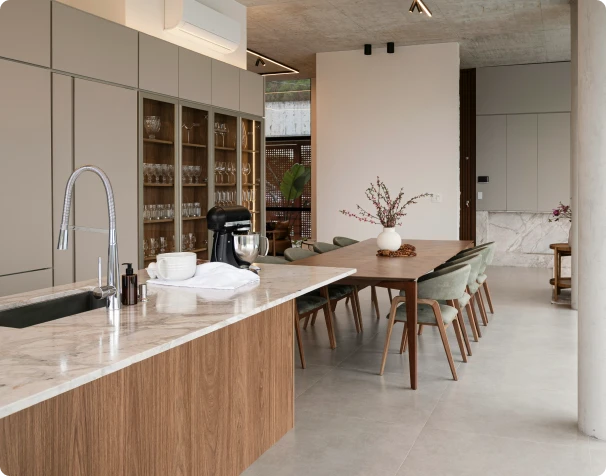
The two decisions that people come back to us about are sheen and the island.
On sheen, a kitchen wants something you can wipe. A flat finish on a cabinet door looks lovely for a month and then holds every fingerprint permanently. A satin or a semi-gloss cleans up and keeps looking clean, and modern cabinet coatings at those sheens are far less shiny than the old oil enamels people remember.
On color, the two-tone kitchen is not a trend that is going away here, and it works: lighter perimeter, deeper island or lower run. It also breaks up a long wall of cabinetry in a way a single color cannot. If you are nervous about it, the island is the low-risk place to take the risk, because it is the smallest run and the easiest to redo later.
Florida light is the wild card. A white that reads warm and soft in a showroom can go stark under a kitchen full of Gulf-side afternoon light bouncing off a pale floor. We bring samples and we put them on your cabinets, in your kitchen, and look at them at two different times of day. That color consultation is included with your estimate.
Every job carries a written warranty of five years or more, covering workmanship and materials. On a kitchen, that is the promise that matters, because a kitchen finish either holds under daily use or it does not.
Since 2011, and Juan has 25+ years in the trade. Cabinets are the work where that experience is most visible and hardest to fake.
The people spraying your kitchen are on our payroll. Cabinet work is a spray skill and a containment discipline, and neither survives a rotating cast of subcontractors.
We set up so the sink and the refrigerator stay usable through most of the job, we clean up daily, and we walk the finished kitchen with you before we call it done.
Usually yes when:
It is a weaker fit when the boxes have water damage, when doors are delaminating across most of the kitchen, or when the real problem is that the layout does not work. We will tell you that at the estimate rather than sell you a finish on top of a structural problem.
Most kitchens run several days from setup to reassembly, and the number depends on door count and how much repair the boxes need. You keep the sink and the refrigerator for most of it. The doors come off early and go back on at the end, so there is a stretch in the middle where the cabinets are open shelving. We give you the specific schedule in writing with the estimate.
Spray, for the doors and drawer fronts, finished flat so there is no brush texture in the surface. Face frames and boxes are sprayed in place behind containment. Anything that genuinely cannot be sprayed gets brushed and laid off carefully, and that is the exception rather than the method.
Often yes, and the answer depends on condition. Sound laminate takes a bonding primer well. Thermofoil that is already lifting or peeling off the door core is a different situation, because paint will not re-adhere a skin that has released. We check this at the estimate by looking at the door edges and corners, which is where it starts.
Door and drawer count first, then the substrate you have, the condition and repair scope, whether the boxes are being finished inside, how much containment the layout needs, and the coating system. We put all of it in a written estimate at no cost so you can see what is driving the number.
Light use returns as soon as the doors are back on. Full hardness takes longer, usually a matter of days depending on the product and the humidity that week. We tell you the specific window for the coating on your kitchen, including when to put shelf liners and heavy items back, before we leave.
The best part of a cabinet job is the walkthrough at the end, when the doors go back on and the kitchen stops looking like a room from a different decade. We would like to do that in your house.
Estimates are free and include a color consultation. Call (727) 334-2348 or request yours below, and we will come out, open a few doors and tell you what your kitchen actually needs.


